
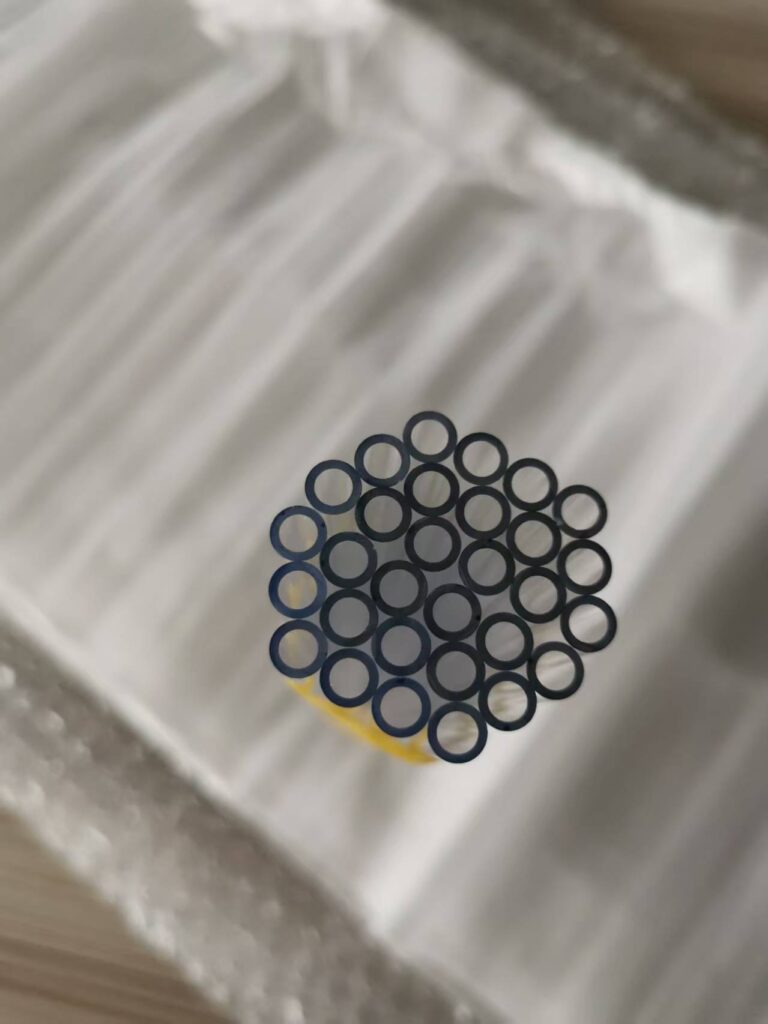
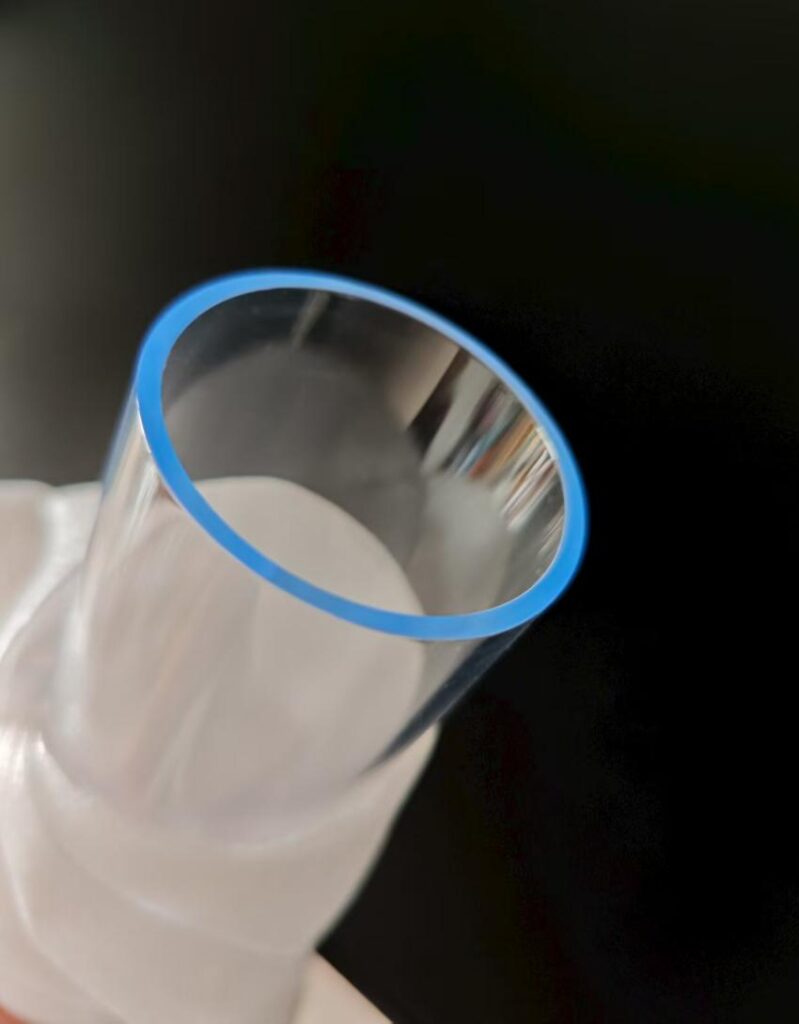
A capillary electrophoresis channel is a very important concept and the core component of capillary electrophoresis technology. Simply put, it is an extremely thin fused-silica capillary in which electrophoretic separation takes place.
You can think of it as a “separation tunnel in the microscopic world” or a “high-speed highway on a chip.”
Core Definition and Physical Structure
Essence: It is simply a fused-silica capillary tube.
Typical dimensions:
The inner diameter is usually 25–100 µm (about the thickness of a human hair), the outer diameter is 150–400 µm, and the length ranges from 30–100 cm.
Anyag:
Most channels are made of fused silica due to its excellent optical transparency (convenient for detection), chemical inertness, and electrical insulation.
Working Principle: An Electric-Field-Driven ‘Molecular Race’
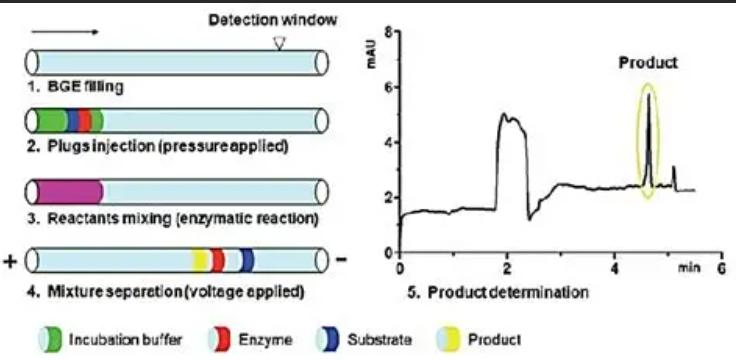
In capillary electrophoresis, the driving force for separation is a high-voltage electric field, rather than liquid pumps as in chromatography. The entire channel (capillary) is filled with an electrolyte solution known as the running buffer.
When a high voltage (typically 10–30 kV) is applied across the two ends of the capillary, the following processes occur, leading to sample separation:
Electroosmotic Flow (EOF)
The inner wall of the fused-silica capillary becomes negatively charged in the buffer, attracting cations to form a compact “cation layer.”
Under a high electric field, this layer of cations drags the entire buffer solution toward the cathode like a “conveyor belt.” This phenomenon is electroosmotic flow (EOF). EOF is the main driving force that moves all substances forward.
Electrophoresis
Meanwhile, sample molecules also migrate in the electric field according to their charge-to-mass ratio.
- Positively charged molecules: migrate toward the cathode, moving in the same direction as EOF, thus traveling fastest.
- Neutral molecules: have no electrophoretic mobility and move only with the EOF “conveyor belt,” so they travel at the same speed and cannot be separated.
- Negatively charged molecules: migrate toward the anode, opposite to EOF. However, EOF is usually stronger than their own electromigration, so they are still “dragged” toward the cathode, but at the slowest net speed.
Final result:
Different molecules move at different speeds in the channel depending on their net charge, size, and shape, resulting in separation. Highly charged small cations reach the detector first, followed by neutrals, and highly charged large anions arrive last.
Key Characteristics
- High efficiency:
Because the capillary is extremely narrow, heat dissipates efficiently, allowing very high voltages to be applied and achieving extremely high separation efficiency (theoretical plate numbers can reach several hundred thousand or even millions per meter). - Speed:
Analysis typically takes only a few minutes to tens of minutes. - Microscale sample consumption:
Only nanoliter-level sample volume is required, making it ideal for precious samples such as single-cell analysis. - Automation:
Injection, separation, and rinsing processes can be highly automated.
Two Main Forms
Conventional Capillary Electrophoresis Channels
This refers to the single fused-silica capillary described above and is the most widely used format.
On-Chip Capillary Electrophoresis Channels
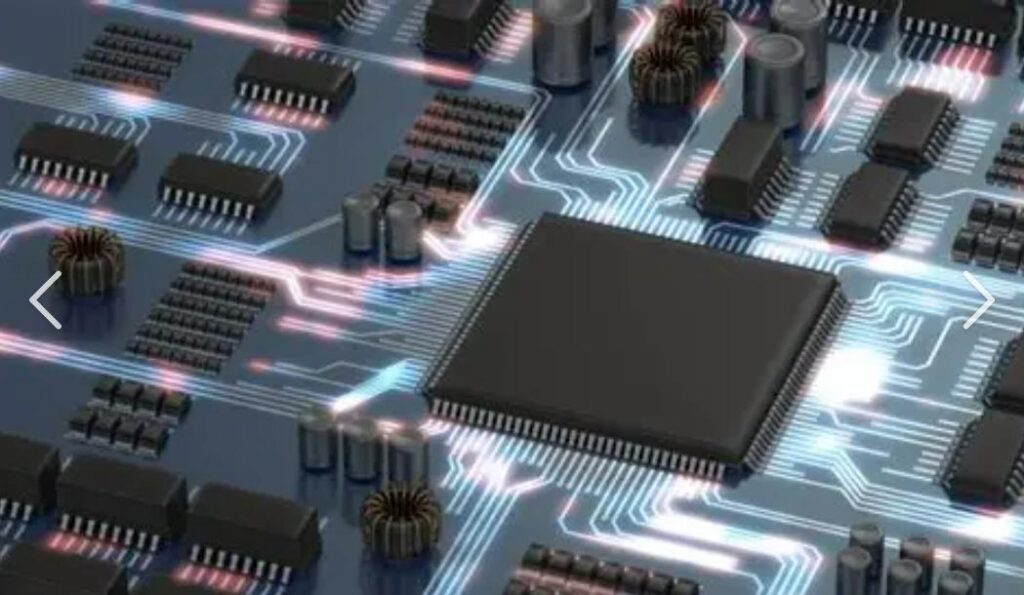
This is the core of microfluidic chip technology. It “engraves” conventional capillary structures onto a flat substrate (such as glass, fused silica, or polymer), forming complex microchannel networks.
Structure:
Microchannels with micrometer-scale width and depth are fabricated on the chip using photolithography and etching techniques.
Előnyök:
- High integration:
Sample pretreatment, reaction, separation, and detection can all be integrated onto a chip the size of a stamp, creating a “lab-on-a-chip.” - Ultra-fast analysis:
Due to shorter channels, separations can be completed within seconds. - High throughput:
Multiple channels can be designed in parallel to analyze multiple samples simultaneously.
Applications: DNA fragment analysis, protein studies, rapid disease diagnostics, etc.
Main Application Fields
Capillary electrophoresis channels are widely used due to their high resolution and high sensitivity:
- Life sciences: DNA sequencing, fragment analysis (e.g., genetic disease diagnostics), protein analysis, single-cell analysis.
- Pharmaceutical analysis: chiral drug separation, purity checks, metabolite studies.
- Food & environmental analysis: detection of additives, pesticide residues, ion analysis (such as anions in drinking water).
- Forensics: DNA fingerprinting.
Összefoglaló
A capillary electrophoresis channel is a powerful tool that uses high-voltage electric fields to separate ions and molecules in microscopic-scale tubing. With its high efficiency, high speed, and extremely low sample consumption, it has become an indispensable separation platform in modern analytical science—especially in life sciences. From a simple fused-silica capillary to a highly integrated microfluidic chip, the core principle remains the same: this “microscopic electric-field racetrack.”

 Hungarian
  English
  Estonian
  Arabic
  Bulgarian
  Polish
  Danish
  German
  Russian
  French
  Finnish
  Korean
  Dutch
Dutch  Czech
Czech  Latvian
  Lithuanian
  Romanian
  Portuguese
  Japanese
  Swedish
  Norwegian
  Slovak
  Slovenian
  Turkish
  Ukrainian
  Spanish
  Greek
Greek  Italian
  Indonesian