
Measuring the inner diameter of fiber-optic grade capillary quartz tubes is a highly specialized task requiring exceptional precision. Because their inner diameters are extremely small (often ranging from a few microns to several hundred microns) and the tubes are relatively long, conventional tools such as calipers cannot be used. Current mainstream methods fall into two major categories: offline methods (high-precision, used for quality inspection) and online methods (fast, used for production control).
Below are several core measurement methods:
Offline Measurement Methods (High Accuracy, Contact or Destructive Methods)
These methods are typically used in laboratories or quality-control departments. They offer the highest precision, though they are slower and sometimes destructive.
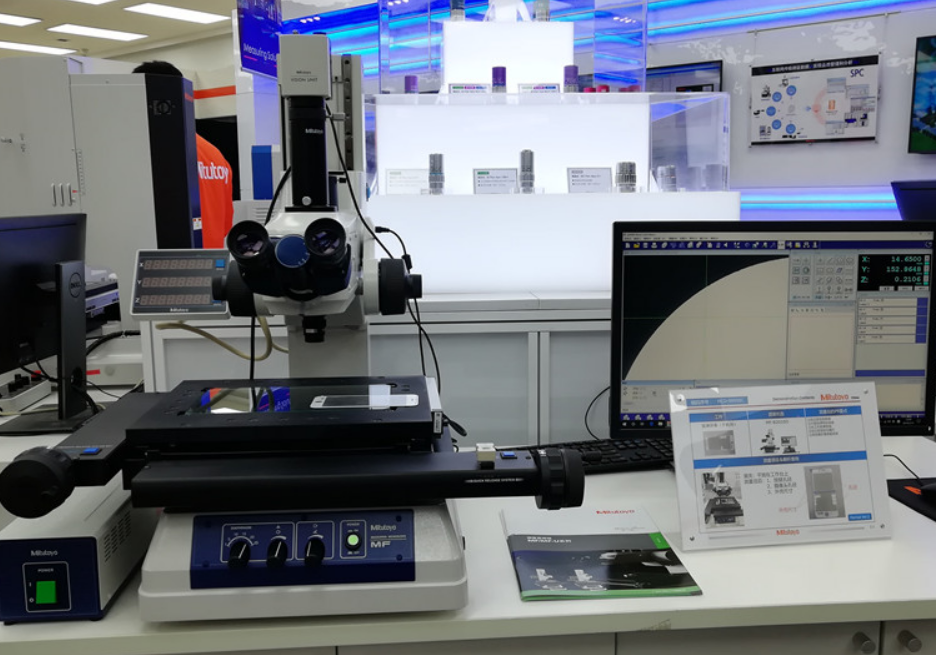
1. Microscope Method (Direct Optical Measurement)
This is the most intuitive and fundamental method.
Principle:
A short section of the capillary tube is cut and its end face is precisely polished. The sample is placed under a measuring microscope or toolmaker’s microscope. The inner diameter is measured directly from the end-face image using the microscope’s reticle or software.
Procedure:
- Sample preparation: Cut a short segment of the capillary tube and ensure the end face is flat, perpendicular, and clean.
- Observation: Place the sample on the microscope stage and adjust focus until the end face is clearly imaged.
- Measurement: Use an eyepiece reticle or software analysis to read the pixel-based diameter, then convert it to the actual size according to the magnification.
Előnyök: Direct, simple, and relatively low cost.
Disadvantages:
- Destructive: Requires cutting the sample.
- Poor representativeness: Only measures the end-point diameter, not the uniformity throughout the tube.
- Operator-dependent: Accuracy heavily relies on preparation and manual measurement skills.
- Not suitable for deep holes: Cannot measure diameter at arbitrary internal positions.
2. Scanning Electron Microscope (SEM) Method
Principle: Similar to optical microscopy but uses an electron beam, achieving extremely high resolution—down to the nanometer scale.
Előnyök: Extremely high accuracy and clear visualization of the end-face morphology.
Disadvantages: Equipment is expensive; samples must undergo conductive treatment (such as gold coating). It is destructive and also limited to end-face measurement.
3. Resin Filling and Sectioning Method (Metallographic Technique)
This is one of the authoritative methods for measuring inner diameter and roundness.
Principle:
A colored epoxy resin or other filler is injected into the capillary tube and allowed to cure. The filled tube is then cut into small segments at fixed intervals. Each segment’s polished end face is measured under a microscope to determine the filler’s diameter.
Előnyök: Provides true cross-sectional shape (roundness) and precise dimensions, offering highly reliable results.
Disadvantages: Highly destructive, complex, time-consuming, and unsuitable for rapid batch testing.
Offline Measurement Methods (High Accuracy, Non-Contact)
These are the current mainstream industrial quality-inspection methods—high precision and non-destructive.
1. Laser Scanning Diameter Measurement
Principle:
A parallel laser beam is projected vertically onto a capillary tube that rotates at a uniform speed. The tube blocks part of the beam; the inner hole allows a portion of the laser to pass through. The detector receives a “shadow” signal that contains both outer and inner diameter information.
Signal Analysis:
By analyzing the time width of the laser passing through the inner hole and combining it with the rotation speed, the system accurately calculates the inner diameter at that rotational angle. After one full rotation, maximum, minimum, and average inner diameters are obtained, enabling evaluation of roundness.
Előnyök:
- Non-contact, high precision (sub-micron level).
- Capable of measuring roundness.
- Fast, suitable for batch inspection.
Disadvantages: Equipment is relatively expensive; the tube must be stably rotated during measurement.
2. Optical Coherence Tomography (OCT)
Principle:
A weak-coherence light interference technology used to image microstructures of transparent or semi-transparent materials. It generates 2D or even 3D cross-sectional images non-destructively.
Előnyök:
- Non-destructive.
- Provides complete cross-sectional information, including inner diameter, outer diameter, wall thickness, and concentricity.
- Very high precision.
Disadvantages: Very expensive equipment, complex data processing, and slower than laser scanning.
Online Measurement Methods (Real-Time Monitoring During Production)
These methods are critical for real-time monitoring of inner diameter in fiber-drawing towers.
Laser Diffraction Diameter Measurement
This is the most central and widely used technology for online control of fiber or capillary inner diameters.
Principle:
- A parallel laser beam of known diameter irradiates the downward-moving capillary tube.
- As the beam passes through the inner hole, single-slit diffraction occurs.
- A diffraction pattern appears on a distant screen, featuring alternating bright and dark stripes.
- The spacing of these stripes is inversely proportional to the inner diameter.
- A high-speed line-scan CCD camera captures and analyzes the diffraction fringes in real time.
- After computational processing, the system instantly determines the inner diameter at any moment.
Előnyök:
- Completely non-contact, extremely fast (thousands of measurements per second), ideal for real-time monitoring.
- High precision, suitable for micron-scale measurements.
- Real-time feedback to the drawing tower’s control system enables automated adjustment of pressure or draw speed, forming a closed-loop control system to ensure uniformity.
Összefoglaló
For production process control, laser diffraction is the irreplaceable core technology.
For final quality inspection, laser scanning and OCT are the most commonly used high-precision offline methods.
Microscope and resin-section techniques serve as supplementary or arbitration methods.

 Hungarian
  English
  Estonian
  Arabic
  Bulgarian
  Polish
  Danish
  German
  Russian
  French
  Finnish
  Korean
  Dutch
Dutch  Czech
Czech  Latvian
  Lithuanian
  Romanian
  Portuguese
  Japanese
  Swedish
  Norwegian
  Slovak
  Slovenian
  Turkish
  Ukrainian
  Spanish
  Greek
Greek  Italian
  Indonesian