
Request Quartz Glass Solution
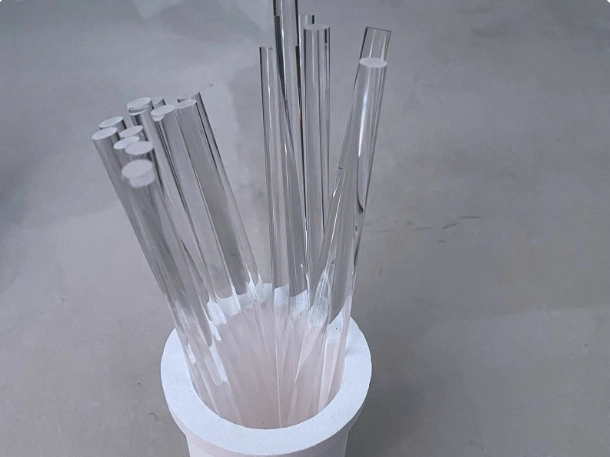
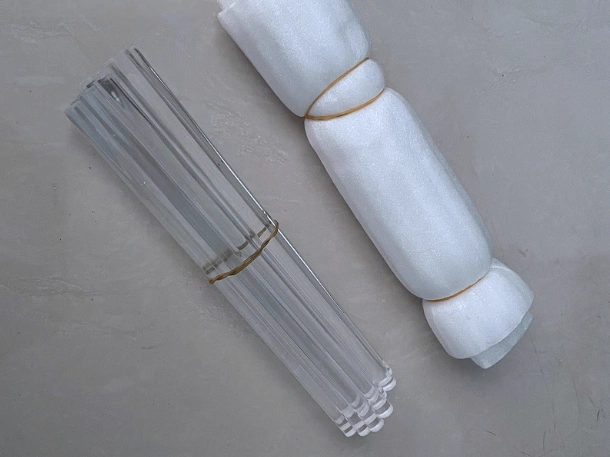
Quartz rods are solid cylindrical components manufactured from high-purity fused quartz glass. They offer excellent optical clarity, thermal stability, and chemical resistance, making them suitable for demanding laboratory, industrial, and high-temperature applications.
Due to the inherent properties of fused quartz, quartz rods maintain dimensional stability under thermal cycling and do not react with most acids, gases, or chemicals. This makes them reliable structural or functional elements in environments where ordinary glass or ceramics may fail.
Application Overview
Quartz rods are widely used in laboratory equipment, optical systems, semiconductor processing, and high-temperature industrial assemblies.
Typical applications include optical supports, spacers, insulating components, structural elements in thermal systems, and precision parts for analytical or research instruments.
Standard Sizes & Supply Range
Our standard quartz rods are solid fused quartz rods with diameters from 0.3 mm and above.
Standard production lengths are available up to 1000 mm.
For longer lengths or special dimensional requirements, custom fabrication is available upon request.
Available Customization
Diameter and length according to drawing or specification
Extended lengths beyond 1000 mm available by custom order
End finish: cut, fire-polished, or precision-polished
Surface finish: transparent, ground, or optical polish
Tight dimensional tolerances for precision assemblies
Custom drawings and technical requirements are welcome.
Thermal Resistance
Transparent quartz rods can be heated in a furnace at 1100 °C for 15 minutes, then quenched in cold water, and can withstand 3–5 thermal shock cycles without cracking.
Opaque quartz rods can be heated at 800 °C for 5 minutes, then quenched in 20 °C water, and can withstand up to 5 cycles without cracking.
Temperature Characteristics of Quartz Rods (Reference)
The following data are provided as material and engineering reference values for quartz rods under different temperature conditions.
| Temperature (°C) | Condition / Description |
|---|---|
| 1100 | Long-term service temperature |
| 1000–1075 | Strain point (viscosity tgn = 14.5) |
| 1070–1180 | Annealing point (viscosity tgn = 13.0) |
| 1200–1470 | Rapid crystal growth temperature range |
| 1600 | Reduction begins, forming glassy silicon |
| 1580–1730 | Softening point (tgn = 7.6) |
| 1710 | Very low vacuum forming temperature; cristobalite converts to fused quartz |
| 1750 | Melting in furnace and onset of volatilization |
| 1800 | Lower operating temperature (≈1% volatilization in 5 min, vapor pressure ≈0.1 mmHg) |
| 2000 | Operating temperature (≈20% volatilization in 5 min, vapor pressure ≈0.4 mmHg) |
| 2500 | Upper operating temperature (≈40% volatilization in 5 min, vapor pressure ≈10 mmHg) |
| 3000 | Secondary oxygen heating; vapor pressure ≈100 mmHg |
| 3500 | Boiling point; vapor pressure ≈760 mmHg |
 English
  German
  Russian
  French
  Spanish
  Italian